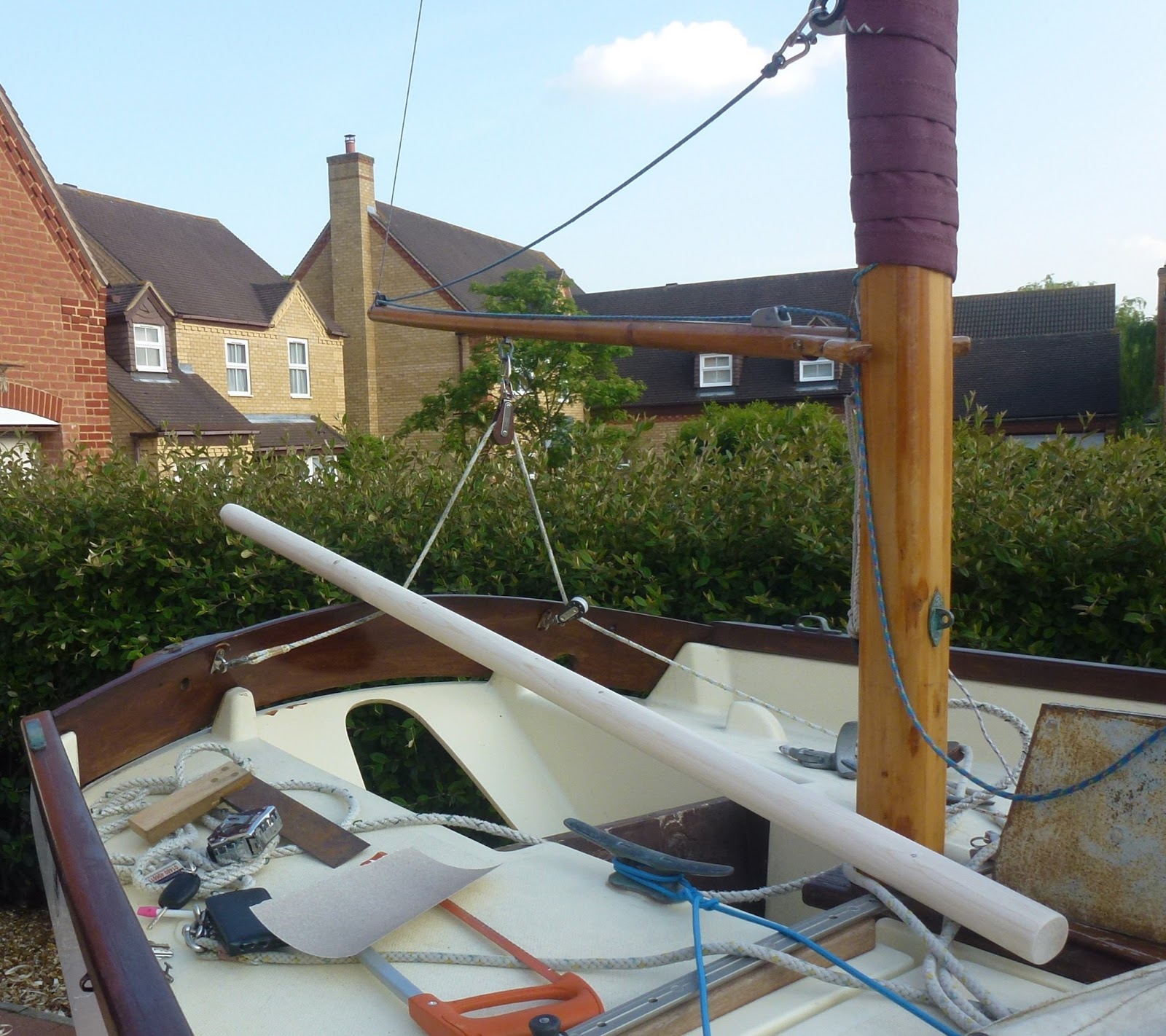
Three nights aboard, with five days sailing isn't a bad sailing return for half term. Daisy II is currently on the trailer, in preparation for next weekend's Wells-next-the-sea rally. This has presented an unusual opportunity to catch up on a few modifcations. Most important of these is the MkII mizzen boom.
During early Spring of 2011, I reported on making a MkI mizzen boom to replace the standard bumpkin arrangement. This was only ever intended as a prototype and, at the time, didn't even warrant a coat of varnish. It survived the whole of 2011 on the mooring, showing little signs of suffering from the elements and providing endless fun, tinkering with the rigging and sail configurations - exactly as had been intended.
So successful was this MkI version that it was varnished, rather than replaced, early in 2012, with rigging rearranged to the final, preferred setting and it spent another season being put through its paces.
There is still nothing much wrong with it. The boom provides endless hours of fun, means that there is no bumpkin snagging on other boats/jetties when in tight spaces, looks sufficiently elegant and presents a much bigger face of sail to the wind, particularly when reaching and running.
Mk1 version, made March 2011 and still functioning well in May 2013
So, why replace it now? The MkII version needed to be more permanent, substantive and to correct the shortcomings of the original: the MkI wasn't quite long enough to provide tension to the foot of the sail (MkII is about 15cm longer) needed to be a little more substantial in girth (MkII 43mm v MkI 35mm) since it tended to bend when sheeted in hard, and I harboured some doubts about the home made jaws - these depended on improvised string to provide tension to the tack of the sail and in keeping the jaws close to the mizzen mast. It is also better to build from a position of strength - with a fully functioning current set-up, rather than working in reaction to a possible future breakage. MkI was made from a ready-made piece of 35mm dowelling; I wanted to have a go at fashioning the new one from original timber.
Lastly, a gooseneck was ready and waiting for use. This had been ordered from Norfolk Marine when the Mk1 was being made but, being cautious at the time, I reckoned on improvised jaws involving less dramatic surgery to the main mast, whilst trialling various rigging and positional arrangements.
Gooseneck
The new boom was made from a piece of 2.4m (shortened to 1.73m), 45x45mm spruce: the least knotted piece to be found in Homebase! Planing along each edge length-wise, this became octagonal and, subsequently, crudely hexadecagonal in cross-section. A surform helped form the rounded end. Sanding with, respectively, 80, 120, 180 grit paper left a reasonably cylindrical piece of wood (in fact, by accident rather than design, slightly oval in cross-section, which is handy in hopefully providing more vertical strength when appropriately positioned). This task took a couple of hours.
Left to right, original timber, after various stages of planing, after sanding
Ring out the old, ring in the new
The gooseneck needed securing to both mast and boom. The mast needed reshaping, since the gooseneck jaws were semicircular, next to the square cross-section of the mast. Using a chisel and Black and Dekker Powerfile belt sander, a horizontal channel was cut in the mast to fit the jaws of the gooseneck - not my best piece of woodwork and a little retrospective filling may yet be in order.
Gooseneck attached to mast
The other end was tapped, gently but securely, into a hole drilled in the non-rounded end of the boom.
Put together, with rigging attached, it looks like this:
New boom, unvarnished but rigged and in place
Everything is now disconnected ready for action from varnish and brush. Next weekend's Wells-next-the-sea rally will provide a great, first opportunity to try out the new arrangement.
The other modification, currently in preparation, copied directly from a device being used by the skipper of coaster Windsong which I noticed at the recent Pitsford Rally, is a wooden support for a ratchet strap used to secure hull to trailer when towing. The design allows the strap to be tightened without causing undue stress to the hull.
Ratchet support
The support will have leather softening on the underside in contact with the gunwhales, and I might need to look at ways of ensuring the metal ratchet itself stays on the support. Again, there will be an opportunity to put this to the test on the way up to Wells-next-the-Sea next weekend.
White track: "Robbie's race" afternoon 29 May; red track, further sailing, later in the afternoon, 29 May; green track, sailing with Jeff Kerr, morning of 30 May.
9.1nm; season's total 154.2nm
Gathering on Wednesday morning, 29 May, guests of Northampton Sailing Club on Pitsford Water.
Participating boats (if any participating skippers can help me fill in the missing name, I'd be grateful):
Luggers Pelican, Fiddler's Green, Muckle Flugga
Coasters Daisy II, Bundy Bear, Windsong
Longboats Serendipity, Harry Cockburn (both 'Sailability' boats)
Peterboat Helena
Dabber Dreamer
Jolly Boat Sally Gee
Deben Lugger ?
Weather "grey" and increasingly wet as the day went on. Winds northerly, F3 gusting F4.
After launching and lunching, "Robbie's race" (white track, above) was the main event of the afternoon. The race is in memory of Robbie Henderson, a Drascomber of old; the trophy created by Churchouse Boats. The idea is to race to Holcot, the far end of Pitsford Lake, round a buoy and then sail back. The race has been run for a number of years, although this is the first time that Daisy II has participated.
Unfortunately, I don't seem to have the hang of this racing lark. While I rigged the jib and raised the main, most of the field had made it to the first bend. I was pleased to have caught up a Dabber and Lugger prior to turning at Holcot.
Pictures of Daisy II bringing up the rear during Robbie's Race
Winds enabled a pleasant reach there and back. By the end of the race, I'd gone past another couple of luggers and an under-powered longboat, but having failed to cross the finishing line, I was thankfully disqualified! The race was won by a coaster, and we seemed generally to perform quite well. Having never been in a race before, this was an interesting experience, but not one I'm anxious to repeat in a hurry.
Robbie's Race in action: everyone else was on their way back!
An interesting side of sailing at Pitsford is that engines are not permitted (except in an emergency). So, I left mine at home - although most of the fleet still brought theirs in expectation of their emergency. Sailing without 30kg of motor on the stern is liberating and I managed a top speed of 5.9kts, and was consistently above 5kts.
The other highlight of this event was the bid for freedom made by lugger Fiddler's Green which slipped its mooring whilst its skipper and crew were in the clubhouse. Fortunately, lugger Pelican was on hand to save the day.
Crewless (clueless?!) Fiddler's Green being rescued by Pelican
After Robbie's race, and a mid-afternoon cuppa, the trophy was presented by Robbie's widow and the rain fell with more menace. A brief lull gave a later window of opportunity for a further sail, so Daisy II stretched her legs with coaster Bundy Bear (red track above). Later that evening, a clubhouse meal was enjoyed by all participants, whilst the rain in torrents flowed.
Rain continued most of the night and Thursday morning began with stronger winds; in particular, a squall at around 4.30am as Fiddler's Green made further trouble with a flogging mainsail. Eventually, I had to go and sort it out but, once awake, was in no position to return to the bunk.
Breakfast in the clubhouse began official proceedings, followed by a 9.30am briefing and a boat jumble, where I picked up a pair of old 'waterproof' trousers, which may come in handy. I changed the winch strap on the trailer, having noticed the old one had begun to fray and did a temporary repair job on the tiller extension which had, once again, parted from the tiller. We also had an opportunity to introduce our boats, history, modifications to fellow ralliers.
Comparing boats
A particular favourite of mine was a wooden 5m Peterboat Helena which, regretfully, I didn't manage to photograph properly. The skipper, Stephen Coulter, had spent the previous winter restoring it - and a brilliant job he made of it. Superbly finished - a real labour of love. If only I had the skill and patience!
Skippers and crew admiring a newly restored 5m wooden Peterboat
For this morning's sail (green track, above), I had company, for once, in Daisy II as Jeff Kerr, skipper of lugger Pelican wanted to try out a coaster. As it happens, the skipper of Windsong was on shore to capture a short piece of video as we set sail.
Jeff helmed all the way to Holcot and worked on various manoeuvres, tacks and jibes, to see how a coaster reacts. Winds had changed to a north westerly and were more variable in force than yesterday, with some F5 gusts. However, we had all three sails up, unreefed and I think Jeff was impressed with the sail and might upgrade to a coaster in due course.
Daisy II in action on second day.
After the morning's sail, it was time to pack up and return to base. Fortunately, the slipway at Pitsford is extremely easy to use, a gentle gradient with adjacent jetty, and plenty of laying up areas.
All in all, this was a very pleasant rally. Good sailing, pleasant company and various ideas taken on board regarding future potential modifications.
Pontoon moorings, courtesy of Northampton Sailing Club, Pitsford Water
This was supposed to be the weekend of the Drascombe Association River Blackwater rally. However, for various reasons, not least of which was a discouraging weather forecast, other boats pulled out. In the meantime, coaster Windsong's Skipper requested the opportunity to tag along, happy to go wherever since "anywhere on the east coast was a long way from Leamington Spa..." I had been serious about going down the coast to the Blackwater, but wasn't completely sure about the forecast. This gave me the perfect excuse to stay in home waters, and then to take Daisy II off the mooring for a few weeks in order to attend rallies at Pitsford Reservoir (later this week) and then Wells-next-the-Sea the weekend after next.
So, on Saturday at around noon, Windsong launched at Woolverstone Marina, and then joined me at Pin Mill for a three day, two night cruise.
Windsong rowing away from Woolverstone Marina - the beginning of an adventure!
The Saturday plan was to sail from the Orwell to a remote anchorage in the Walton Backwaters. We began by motoring upstream to anchor off Freston, whilst Windsong's skipper sorted out the cabin and I made some lunch.
Winds were North to North-westerly Force 3 gusting 4, so we had the wind with us all of the way to the Backwaters. Windsong's rig has the yard hanging off the mast and creates a square sail - more power up top. We both had reefed main with jib, but opted to do without the mizzen.
Sailing down the Orwell
We reached Landmere Creek, off Hamford Water at about 5.30pm and settled down for an evening of beer, wine and food, listening to the wildlife and eventually retiring to respective cabins for some well-earned rest.
Sunday morning, winds were much the same as yesterday. The plan was to motor sail out of the Backwaters, starting at 8am, and catch the flood from Harwich harbour all the way up the Stour to Manningtree. The plan hatched perfectly and even allowed us to do without any engines: perfect Drascombe sailing. In Harwich harbour, there were absolutely no container ships at Felixstowe's Trinity Terminal, so we were able to reach across the harbour and then tack back across towards Harwich. We then tacked up the Stour, reaching Manningtree by 12.40pm. Lunch at anchor presented an opportunity to exchange experiences with the morning's sail.
The afternoon allowed us a short amount of time, on an already ebbing tide, to motor around Manningtree. We then set sail for a wonderful reach down the Stour.
Windsong in Holbrook Bay, returning from Manningtree
Pamela Jean caught napping off Erwarton.
Windsong under attack from giant dangling warp
Windsong sailing down the Stour
There was also an opportunity for some video footage as we sailed along the Stour
Rounding Shotley Point, the tide was continuing its strong ebb, and we were not able to manage under sail alone. So, we decided to motor up the Orwell to Pin Mill, sharing my mooring and further beer, wine, food and conversation.
Daisy II and Windsong at Pin Mill
On Monday, we took a morning sail with the flood upstream, under the Orwell Bridge and into Ipswich, before parting at Woolverstone, both boats taken out of the water in order to attend the midweek Drascombe Association Pitsford Reservoir rally.
Windsong framed by the central span of the Orwell Bridge
Dumper truck, being dumped!
56.2nm; white track Saturday - Orwell to Walton Backwaters; red track Sunday - Walton Backwaters to Manningtree, then back to Pin Mill; green track Monday - Pin Mill to Ipswich and back; season's total: 145.1nm
This is a log of sailing activities aboard Daisy II, a 22ft Drascombe Coaster No.280. Formerly named Aquarius, she was built in July 1997 by Honnor Marine(UK) Ltd of Totnes, Devon. The original Daisy, a Devon Lugger, was purchased in 2005 following an unexpectedly early opportunity to realise a mid-life crisis! Daisy II, with cabin, afforded more scope for overnight stops, and was purchased at the end of 2006.
For several seasons she was moored at Pin Mill on the River Orwell, Suffolk. More recently, the trailer sailing option, utilising a versatile ‘roller coaster’ road trailer, has extended the sailing range. Over the years, we have sailed from various locations off the south coast from Cornwall to Hampshire, a number of inland reservoirs and the Norfolk Broads. However, her key stamping ground is the east coast, usually based around the Harwich area and reaching destinations ranging from North Kent up to Southwold, whilst also launching on the North Norfolk coast at Wells next the Sea. Most recently, a trip from Harwich to Whitby has served only further to whet the appetite: perhaps, one day, Daisy II might complete her journey, in small stages of course, around the UK!