Showing posts with label Summer Cruise. Show all posts

Tuesday, 7 August 2018

Plymouth to Paignton (and back) - south west cruise

207nm

Launching fees: £0 - using the excellent public facilities at Mount Batten, Plymouth
Car and trailer parking: £0 - on street parking
Marina berthing fees: £0 - why bother when you can spend seven nights in free anchorages?


This is my brand of cruising, and proves that boating doesn't have to be expensive.  Anchoring isn't difficult and, in Drascombes which can take the ground, can be flexible and peaceful.  I find it works best to avoid the 'known' anchorages since, what the guidebooks really mean is somewhere for a deep keeled boat to avoid grounding.  Look for somewhere close in to shore, with a reasonably flat, non-rocky sea bed. Arriving at low tide helps one appreciate the lie of the land in this respect.  In this way, one can find real seclusion.


Day 1: Plymouth to Salcombe
I actually trailed down the previous evening, slept aboard on the trailer on the road adjacent to the slipway and then launched early the next morning.  Apparently, this slip can get very busy, and the 'free' parking can be difficult to find at such times.  There were no such problems at 7am on a Tuesday morning.  I did pop back the following Sunday just to check the car and trailer were still there, and the free parking was all being used.  If you like, there is the option of paying to park on Mount Batten Centre land, but this is costly at £10 per day (£5 for car, same for trailer) and the car park looks no less secure than the open road.
There is a choice of two slipways, and both look good - the wider one looks good for all tide usage.


After launching, I popped over to Barn Pool to anchor for breakfast. 
Breakfast at Barn Pool


It was just after HW, and there had been gales over the previous few days so, despite winds being light and southerly, there was a punishing swell beyond the Plymouth breakwater -in fact, seas were breaking over the breakwater.  As ever, photos don't do it justice, but it was a bumpy trip, mostly with the tidal flow up to Salcombe.  Initially, I was tempted to turn back and wait for promised better weather later in the week, but was glad to stick with it, rewarded by a challenging sail and much relief once I'd rounded some very confused tidal races off Bolt Head, anchoring in the relative comfort of Starehole Bay for a late lunch at low water.

Great Mew Stone looks untroubled and the camera does a good job of flattening the sizeable swell.
Anchored for lunch in Starehole Bay.
After lunch, a comfortable sail over Salcombe bar into the harbour brought back memories of a previous holiday here over a decade previously.  I found a safe holding anchorage, waiting for the tide, off Halwell Point at the end of the main Salcombe moorings.
I was waiting for sufficient water to take me further upstream to Kingsbridge.  The reward was a lovely quiet anchorage on a falling tide - Daisy II dried out on seaweed and all was still until the tide returned the following morning for breakfast!

Perfect evening anchorage, drying out overnight, opposite the lights of Kingsbridge


28.5nm


Day 2:  Salcombe to Dart


The swell hadn't diminished overnight.  In fact, winds the previous afternoon seemed to have whipped up the seas even more and, again, I was tempted to give in but persisted.  Once beyond Prawle Point, I felt comfortable setting sail in F4 southerly winds.  The promised tidal races off Start Point, intriguingly, hadn't yet set in and, having given it a wide berth, I followed a catamaran across the projected position of these races into the welcome comfort and shelter of Start Bay for a very pleasant run along some splendid shoreline along to the River Dart.

Again, the camera has flattened some challenging seas off Start Point.

Entrance to the River Dart

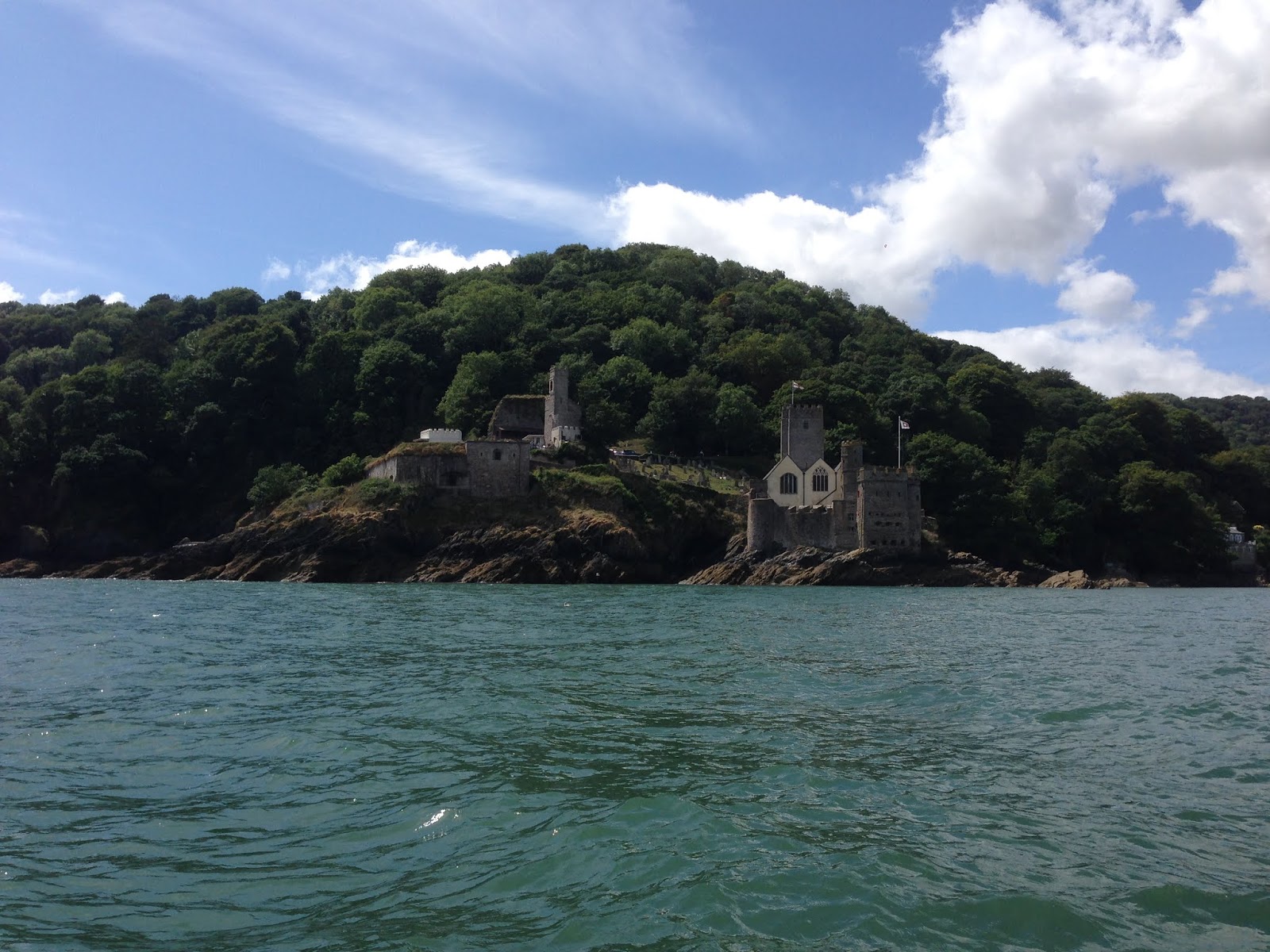
Kingswear Castle guarding the eastern shoreline of the entrance to the River Dart...

...and Dartmouth Castle guarding the opposite shoreline


Dartmouth is an impressive and busy place for mariners.  I motored carefully through the initial parts of the harbour, picking a safe passage amongst the many chartered boats and ferries.  I was aiming for a known anchorage just off Dittisham Mill Creek and, tired from previous exertions, was content to stop there mid-afternoon into the evening, remaining afloat.


25.9nm


Day 3: Exploring Dart and return trip to Tor Bay


The trip upstream to Totnes was charming, if windless.  Totnes is something of a pilgrimage for Daisy II marking her return to the site of the factory at which she was built in 1997.  The factory has long since disappeared since the demise of the old Honnor Marine business in that same year.  I understand the original factory was somewhere on the bank beyond the ferry in the picture below.


Public moorings at Totnes.  Daisy II was 'born' here 21 years ago...
 Totnes is a charming place, not least since there are free moorings close to the town centre.  This was a welcome opportunity to restock the ship's larder at a nearby supermarket, and also to make use of an independent deli, filled with all sorts of treats.


Leaving Totnes behind, the next stage in the voyage involved a splendid sail, in a southerly breeze, round the Mew Stone, marking the eastern entrance to the Dart, along the coast to Tor Bay and the 'English Riviera'.
East Blackstone marking the turn of the coast NE to Berry Head

Berry Head and the entrance to Tor Bay.
 Whilst in Tor Bay, winds shifted to an easterly direction, which would have made for uncomfortable anchoring.  So, after a brief glide past Brixham and Paignton, the decision was made fire up the engine and return to The Dart for the night.
Mew Stone on the return to the River Dart

Dried out for the night off Gurrow Point


37.7nm


Day 4: Dart to Salcombe
Bow Creek, which has a handy pub with moorings - not utilised on this trip but noted for future
HW was later in the morning, so it was good to explore further the upper reaches of the Dart, before taking the ebb downstream and out into Start Bay.


Delightful shoreline shapes in Start Bay

Afternoon anchorage off Slapton Sands
The return to Salcombe involved close encounters with sea mist, and with the Black Stone off Start Point, on which I managed to scrape the centreplate.  Another near miss...  Once back in Salcombe, I returned to the previous anchorage on the shoreline opposite Kingsbridge.


36.2nm


Day 5: Salcombe to River Yealm
Day 5 began with an incoming tide, and the opportunity once again to explore the upper reaches of an estuary.  So, Frogmore Creek beckoned.  It's another creek at the end of which ought to be a pub but no evidence was seen.  Row/sailing was employed with the ebb when returning to the main channel of the estuary, including a pleasant beat along the reach up to Halwell Point.  At this point, the wind was shielded by the hills around the estuary, so engine was deployed to begin the long trip round Bolt Head and back down the coast to the Plymouth area.
Craggy rocks guarding the western entrance to Salcombe Harbour
 The seas, for the return trip to the Plymouth area, were much calmer.  Gone was the residual swell from previous storms.  Unfortunately, gone also was the wind altogether and the outboard was deployed rather more frequently than would have been wished.
Intriguing caves on the shoreline between Bolt Head and Bolt Tail.
Hope Cove - memories of previous beach holidays here...


Burgh Island


The target was to reach the River Yealm - a delightful smaller estuary, almost entirely devoted to leisure boating.

Entrance to the River Yealm.  The white triangular navigational markers evident, mid picture, amongst the trees help sailors navigate a passage avoiding the sand bar which stretches from the northern shore across a substantial part of the entrance.

The River Yealm is another absolute delight.  I found a covenient evening anchorage to dry out in mud off Shortaflete Creek.


27.1nm


Day 6: Rivers Yealm to Lynher
The first job today was to explore the delightful River Yealm.
Public pontoon with facilities on the River Yealm.  The harbourmaster was happy for me to stop here for 20 minutes, which was handy, amongst other things, for recharging my water supplies.


It was pleasing, today, to return to Plymouth and explore this wonderful estuary prior to pulling out.  Working my way round the Great Mew Stone I had intended to explore Cawsand Bay on the western side of the breakwater.  However, a good F4 south easterly made a lunchtime anchorage on the other side a more sensible proposition.
Passing through the eastern channel, I could see plenty of yachts anchored in Jennycliff Bay, and as I headed towards them, I was hailed over the VHF by the skipper of Drifter 22 Puffin, who had initially advised me on sensible launching locations for this trip.  I pulled up alongside for lunch and a pleasant chat. 
It was then time to part company.  Initially, I wanted to check that the car and traiiler were still ok, having been abandoned six days earlier in a public place.  Fortunately all was fine.


The public jetty at Mount Batten makes a very convenient place to go ashore for short periods.  Pulling up on the inside, here, one avoids the regular ferry running between here and other parts of Plymouth. 
The next area to explore was the Hamoaze area, taking a good look at the extensive naval facilities at Devonport.


In the foreground, a submarine is moored.  We don't see many of those on the east coast!  Interesting to note the depths  just off Barn Pool on the entrance to Hamoaze which are in excess of thirty metres.
Finally, I headed up the Lynher River for another delightful anchorage in the lea of Ince Castle.


23.3nm


Day 7: River Tamar, then return home
The plan, today, was to head as far up the River Tamar as tides would allow.  In the event, whilst the tide was favourable, winds were very light and I indulged for rather too long at low speeds prior to resorting to the engine.
Still there were some splendid scenes, particularly of bridges.


  Calstock is, I understand, well worth the trip but, in the event I only reached as far as Cotehele Quay which, nonetheless, made for a very pleasant lunch stop.
Cliffs off Weir Point, near Cargreen


Lunch stop at Cotehele Quay


After lunch, I encountered the coaster Dewinieth with its wonderful high peaked main sail.  It looked a bit of a handful - not sure I'd want to be working with that much sail, but a real picture, nonetheless, and very effective at working upwind.


Coaster Dewinieth beating south towards the Tamar Bridge.

Fortunately, Dewinieth's skipper took some return pictures of Daisy II!


Finally, I worked my way back along the Hamoaze, before passing through the Drake Channel and returning to Mount Batten, and the long dive home.

28.3nm
Finally, a bit of video taken throughout the trip:


Monday, 28 August 2017

Summer Cruise, August 2017

Arrival at Whitby on Sunday, after 247 nautical miles!
Imray's chart, C29, is entitled 'Harwich to Whitby'.  So I did!  It seemed like a worthy challenge... and, as East Coast Representative for the Drascombe Association, I thought I ought to explore a little more of the area.

247nm (est.)
Of course, there was nothing impulsive about this trip - it had been long in the planning and much of the summer holiday was spent awaiting favourable winds and tides.  I had intended to go a fortnight or so earlier, but the weather had been far too windy to contemplate long days out at sea, particularly for the planned trip across The Wash.  Fortunately, things fell into place for this week and the opportunity was not to be missed.

Day 1: Sunday 20th August, River Orwell to Southwold
Today's destination was flexible - Southwold or Lowestoft.  Lowestoft would cut the sea hours the following day, Southwold is far more picturesque.  In the event, I opted for the nearer port knowing that this would most likely add a day to the journey.  I wanted to reach Wells before contemplating a trip across The Wash and it would just be a step too far to make Wells from Southwold in one day.
I launched at Woolverstone Marina just before HW (11am) having arranged to leave car and trailer here until my return a week later.  Winds were light and I found myself using the engine more than I would have liked for the trip up the coast.  The ebbing tide would be with me for much of the trip, at least until Aldeburgh.
Military hangers off Orford.
Orford Ness lighthouse
 The tide did indeed turn at some point off the nuclear power station at Sizewell.  Sails were dropped, and I motored for port.  Even though Southwold was visible in the distance, it took several hours of motoring to reach port.  Tide was still in the early flood at this stage, and tidal currents in the River Blyth had still to reach their peak, which made mooring much easier.
Secure on the new visitor's jetty at Southwold - a fine facility.

Day 1: River Orwell to Southwold, 36.5nm

Day 2: Monday 21st August, Southwold to Blakeney

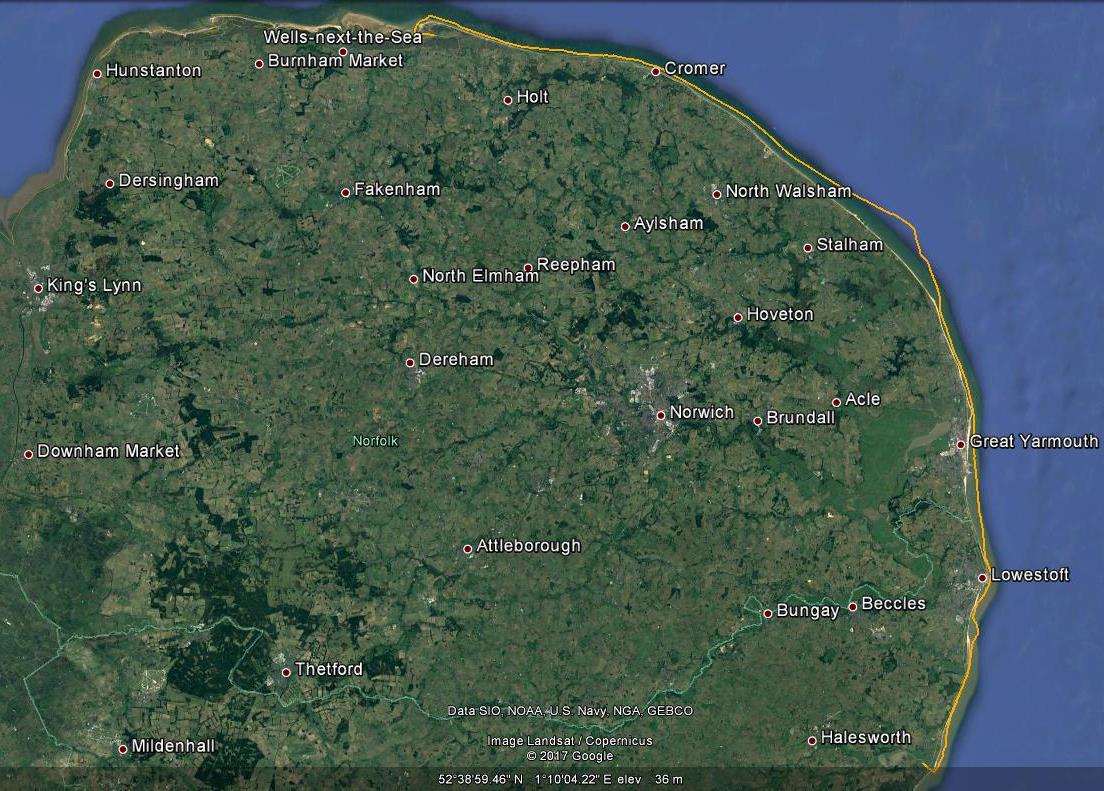
This was going to be an exceptionally long day at sea.  I departed from Southwold at 0500, knowing that the tide wouldn't turn in my favour for at least another four hours.  There is a considerable difference.  A favourable tide means speeds of 6+ knots with a modest power input; tides against mean speeds of just over 3 knots with considerable power input.  The calculation today was that I would have a full 6 hours of favourable tides and this needed to be exploited to the full to reach Blakeney harbour.


Leaving Southwold.  It was actually considerably darker than this; the sun was about to rise and Southwold, from the north east, was covered in a blanket of mist.

Sunrise at sea is always a treat.


I took a series of snaps of erosion, knowing that the media has made much of the loss of land and buildings along this stretch of coast.  The evidence was clear to see.


At a point between Winterton and Sea Palling, I was directed a couple of miles away from shore whilst several large tugs and ships conducted a salvage operation for several 500m lengths of floating piping.

Floating piping out at sea.
The tide turned in my favour soon after passing Great Yarmouth.  I had made great use of engine up to that point.  Thereon, I enjoyed a lengthy stretch of pleasant F3/4 winds under sail until Cromer when the wind dropped.


Cromer
Sheringham
I needed to be at Blakeney Bar by 1930 HW which was managed.  However, a few hours prior to HW, the tide along the coast sets in an easterly direction.  So the final three hours were made with the help of the outboard.  It was questionable as to whether I could have continued to Wells.  I probably might have managed it, but light was already beginning to fade, and I fancied a look in Blakeney harbour, picking up one of several vacant moorings for the night after 14.5 hours of non-stop motion!


Southwold to Blakeney: 62.1nm
Day 3: Tuesday 22nd August, Blakeney to Wells-next-the-Sea

The considerable exertions of the previous day had taken their toll.  The best thing for today was to hop round to Wells and spend the day there, restocking and planning before the next anticipated long haul across The Wash to The Humber.
I left Blakeney probably later than intended and slightly underestimated the relatively short trip to Wells, nevertheless making it by about 90 minutes after HW.  I was against the tide all the way and was heartily relieved to tie up, as instructed by the Deputy Harbour Master, next to a fishing boat on the pontoon at Wells.
Seals off Blakeney Point
 Once at Wells, I was able to recharge the battery (literally), and replenish supplies, particularly by setting off on a long trip by foot to the nearest petrol station, which it turns out is 5 miles away.  Fortunately, kind members of the public took pity on me both ways and I probably walked only about half of the 10 mile round trip - and had plenty of blackberry stops along the way, as well as a lovely pub lunch in the village of Binham.  Still, I had all day in which to achieve this, and it was a splendid day with virtually no wind.  However, why Wells itself doesn't merit a petrol station, we shall never understand.
In the evening, several fishing boats returned including one lowlife skipper whose wash pushed a whole load of sandy scum all over Daisy II's bows and on the cabin top.  This picture was taken after spending much time attempting to clear things up...


Blakeney Harbour to Wells-next-the-Sea, 9.2nm

Day 4: Wednesday 23rd August, Wells-next-the-Sea to Tetney Haven (River Humber)
This was always going to be the most arduous passage of the trip.  In retrospect, I chose a silly route in steering away from shore.  I should have followed initial instincts which had been to work a passage over to somewhere close to Skegness, avoiding the several wind farms of course, and then up the coast.  It's a lonely place, out at sea with no land in sight and The Wash presents tricky conditions.  Today, a relatively light, but nonetheless noticeable south-easterly made for some very rocky seas, and visibility was poor.  Once away from Wells, I didn't spot land again until entering the firing range off Donna Nook, close to the intended destination.
To cap off a difficult day, the GPS kept cutting out, something I subsequently gathered may well have been a loose connection at the positive terminal on the ship's battery - but I didn't spot that until a few days later...
Anyhow, today was not a day for photographs until close to Tetney Haven itself - an anchorage which most certainly didn't disappoint.  In fact, I was mightily impressed by The Humber in general, and look forward to returning one day for a longer cruise in this area.

Inner Dowsing navigation marker

Haile Sand Fort, River Humber - a welcome sight since, the area to the rear right of the picture is Tetney Haven, my intended anchorage for the night.
 Tetney Haven itself didn't disappoint and provided a welcome sanctuary.  Arriving, as I had planned, near to HW, I found, easily enough, the strange channel into the haven, as described by Henry Irving in his excellent Imray publication: Tidal Havens of The Wash and Humber.  Eventually, I cast anchor in the middle of the dozen or so moorings from the yacht club here, having accepted advice from a local yachtsman.  The thing that was most noticeable was the roar of the tide as it subsequently left the Humber.  In our sanctuary, we were protected by a high bank of sand known locally as The Whaleback.  Drying out, it was another pleasant, still night of sleep.
After four days out at sea, the ship's fridge ceases to be effective, so I have to forage in the lower locker areas for sources of potential food...  Still, OSH doesn't hurt...


Wells-next-the-Sea to Tetney Haven, River Humber: 52.8nm
Day 5: Thursday 24th August, Tetney Haven to Bridlington
Yesterday's was the most difficult passage.  Today, once having negotiated my way across the mouth of The Humber and clear of Spurn Point, the excellent weather forecast offered reason for much optimism for the final two legs of the journey.  I set off at HW 0830, intending to reach Bridlington by about 1800 which would be about an hour before its HW.
It is difficult working across the several shipping lanes at the mouth of the Humber. As ever, ships which seem miles away suddenly approach in full view just as one sets across their path.  I cut things a little fine negotiating my way across the final shipping channel today, but made it just.  Then, it is necessary to steer a wide berth around Spurn Point due to challenging eddies.  The trip up the coast, however, was truly splendid. Westerly winds were pushing me further and further out to sea whilst under sail.  So, once clear of the two wind farms in this region, I furled sails and motored back to shore before setting sail once again for Bridlington harbour.

Approaching Bridlington under sail - full main with reefed jib.

Safely moored at Bridlington - an excellent harbour with good facilities.


This turned out to be quite atmospheric, as a shot taken early the following morning.  The reason for taking it, though was the image of the rusting fishing vessel to the right which was named Budding Rose.  Yes, we're in Yorkshire, and that is Yorkshire humour...!
Tetney Haven (on The Humber) to Bridlington: 46.7nm


Day 6: Friday 25th August, Bridlington to Whitby
And so it came down to the final day.  Winds were, again, light and westerly/south westerly.
I set off at around 0800, an hour or so before HW.  The tide was already helping me on my way, and I had an inspiring couple of hours looking, close in, at 'nature's cathedral' - the several miles of cliffs, stacks, buttresses and caves which constitute Flamborough Head.

The inspiring Flamborough Head - nature's cathedral!
Thereafter, I swept in as close as I dared to Filey Brigg, and then even closer in to Scarborough.  Winds had been very helpful up to this point, but dwindled somewhat as I approached Robin Hood Bay, by which time the tide had also turned against me, so I motored the final 6 miles or so to the destination of Whitby, as photographed at the head of this post.
Once inside Whitby harbour, I had to wait half an hour before Whitby bridge became operative two hours before HW, and then found my way to Whitby Marina for the night.
Whitby Marina


Bridlington to Whitby: 39.8nm
This wasn't, of course, quite the end of the excitement.  I needed to use public transport back to home in Cambridgeshire, and then was driven back to Ipswich to pick up car and trailer.  The next day (Sunday), I drove the trailer up to Whitby early in the morning and took Daisy II out of the water close to HW at the excellent slipway adjacent to the marina, prior to driving back home.

I've made it to Whitby.  What next?  Well, another summer, another challenge: Whitby onwards! The Tyne and Lindsfarne sound appealing.  Moreover, having holidayed there previously, I have an ambition to make it over The Forth to Anstruther in East Fife!