Monday, 24 June 2013

Summer lows!

Typical!  A low pressure system parked over the UK all weekend.  High pressure mid-week...
Passing squall.  Photos always seem to make the sea look smoother!
The only photos to be taken today were from the safety of the cockpit at anchor...
...too busy hanging on at other times...!
The plan had been to go for a cruise this weekend, but forecast winds SW F5-7 on both Saturday and Sunday put paid to that.  In the end, I was grateful for sailing, on both days, along the Orwell anchoring off Trinity Terminal Docks for a while, and then working my way back.

Particularly on Saturday, the Orwell was deserted and conditions looked worse in Harwich harbour.  A ferry managed to collide with Parkestone Quay on Saturday and, much as I'd like to have sailed round to look, put up with a gander at the bbc report.  On both days, hanging out a scrap of jib would have been sufficient, and gave me a top speed of 6 knots running down the Orwell towards the turn at Levington.  On Sunday, I braved using both jib and mizzen, and had a fantastic, if hair-raising reach from the turn to and from Shotley Point.  It was a day, however, for keeping a careful watch on the clouds - when the squalls arrived, they packed a punch and it was no time to be sailing; thankfully, I was at anchor at such times.

7.3nm Saturday, (yellow track), 7.4nm Sunday (red track); Season's total 196.2nm
Postscript!
Further photos have been added to the Wells-next-the Sea rally, including a dropbox link to several hundred pictures!

Monday, 17 June 2013

Return to the Orwell, 16 June

Following a couple of hugely enjoyable Drascombe Association rallies, it was good to return to base.

Things were not entirely straightforward, however.  Firstly, neap tides meant a lack of water to launch at Pin Mill and, whilst this hasn't stopped me in the past dry-launching onto the mud, this method is not without its trials: for one, it has the potential to grind off some anti-fouling from the hull.  So, I played it safe and launched, at some expense, upstream at Woolverstone Marina.  Perfectly straightforward slip, but vastly under-used, and one can see why when I was charged £29.75 for a one-way launch.  I'm sure such steep charges are intended to put off custom and this is a real shame since they have plenty of room for laying up, sufficient space for two or three boats to launch at once.  They could make much more from this if charges were reduced and a handy jetty was built to tie up temporarily whilst removing car and trailer.  This is the first time I've used this slip and, all being well, 'twill be the last for some years...

Today's log was hampered by a boat having parked itself on my mooring which meant lumbering up and down with dinghy in tow until a message was received from the boatyard to put the boat on any vacant mooring.  At this point, it was time to go home anyway, exactly the point when the wind decided to pick up to a reasonable blow.  
However, hampered sailing is better than no sailing...  Hopefully, the weather will hold for reasonable sailing next weekend and beyond.
3.9nm; season's total 181.5nm

Sunday, 9 June 2013

Wells-next-the-Sea Drascombe Association Rally, 7-9 June, 2013

Luggers Piper and Snowgoose in Holkham Bay
Finally, I made it to a Wells-next-the-Sea rally, previous efforts being defeated by a blown turbo about 7 years ago, followed by several years of clashes with other rallies. It was well worth the wait!

Wells-next-the-Sea, approaching from the North Sea
Sailing at Wells is governed by tidal windows which are comparatively brief.  There were two sailing opportunities on Saturday - early morning and evening.  Admiral's orders were to be ready to set sail at 06.05 on Saturday morning.  Oddly enough, this was just about the only time the sun shone!
A trio of coasters at 05:15, Saturday morning, ready for the forthcoming fleet action.
So, at 06:05 on 8 June, we set sail.  The original aim had been to make a two-tide trip to Burnham Overy, drying out over lunchtime and then sailing back in the early evening.  North-easterly winds put paid to that idea.  Instead, having motored out of Wells harbour, we had the most marvellous time reaching one way and another in Holkham Bay.  The log demonstrates a determined effort to colour in this area over the three sails (Saturday morning, evening and Sunday morning).  Google Earth's weirwolf-like image of the extensive sandbank, known as "Bob Hall's Sand," framing this shoreline shows why, despite the north-easterly wind, the bay remains fairly sheltered.  Waves were increasingly pronounced the further north west we ventured.
Google Earth image of sailing track.  The town of Wells-next-the-Sea is at the left hand foot of the image, and we were based at the pontoon next to the quay here.  The image shows the relatively new construction of the outer harbour, which is for vessels servicing various shoal wind farms springing up in the North Sea.  This has made necessary the dredging of a new channel from the outer harbour - controversial since it has made the leisure sailing area in Holkham Bay less accessible for some.  The channel from the outer harbour south to the town has also been redirected since my older chart had been published.  Fortunately, I've downloaded the new 2013 version onto my Imray ipad app - expensive but (I keep trying to convince myself) absolutely necessary!
Saturday morning (white track: 10.9nm), Saturday evening (red track: 6.1nm), Sunday morning (green track: 6.4nm); total 23.4nm: season's total 177.6nm.

Winds were a consistent north easterly F4, and the bay provided plenty of waves for fun without being overwhelming for Drascombes - in fact, perfect Drascombing weather (excepting the lack of sunshine!).  During the course of three sails, I managed to take various snaps, together with some video footage.
Various Drascombes in Holkham Bay
Lugger What-knot 
Longboat Cruiser Alouette

Lugger Jimbo heeling
Lugger Jimbo and crew!
Various Drascombe shots
Blue hulled lugger - Tamarisk
Lugger Snowgoose with majestic, dual batten-roached main and mizzen sails
Lugger Piper
Longboat cruiser Alouette
Lugger What-knot
Coaster Liberty Jane
Lugger Piper chasing Scaffie Honeysuckle Rose
Coaster Gabriel Oak
And, finally, a picture of Daisy II, kindly sent by the skipper of Jimbo.
Coaster Daisy II, (picture kindly provided by Yann, skipper of Jimbo)
Later on Saturday, I walked over to see what it all looks like at low tide...
Holkham Bay at low tide
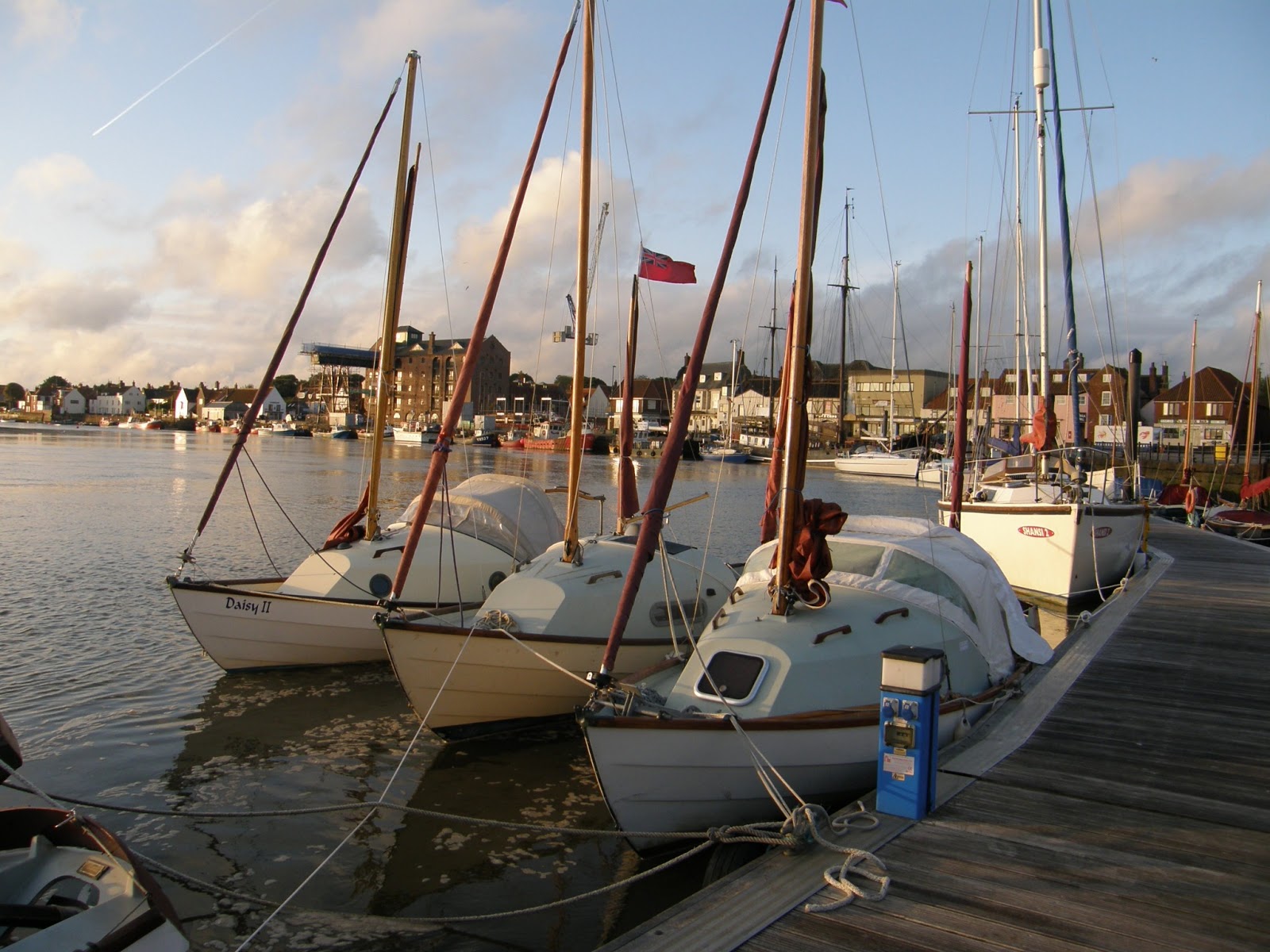
Complimentary moorings on the pontoons were kindly provided by the harbour master at Wells.
Pontoon moorings at Wells, with the town quay beyond

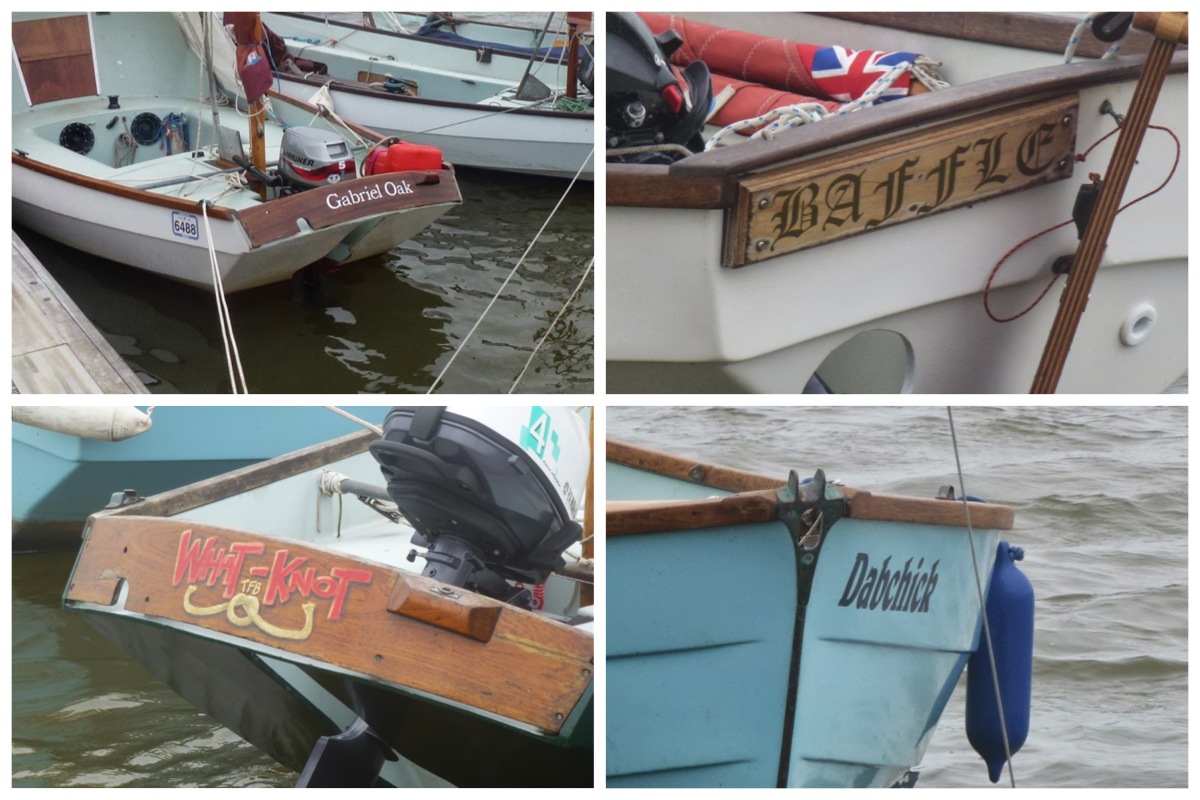
What's in a name?
On Saturday evening, following a second sail, we were treated to a picnic barbecue on the beach near the bay, an area cunningly known as 'Big Gap Dunes'.
Approaching the barbecue
Barbecue at Big Gap Dunes

Beached Drascombes!
(as another contributor noted) the patent Drascombe Galley (photo courtesy of Richard and Carol Clammer)
After a third sail on Sunday morning, it was sadly time to be on our way!
Drascombe departures from the public slip, Wells-next-the-Sea.  I bided my time with this one - this is a steep slip, particularly at the top and with little room for manoeuvre, leading as it does onto a narrow road.  There is a driveway opposite which could come in handy as an escape road!   All boats were safely recovered; I still managed to shave a couple of thousand miles from the front tyres when pulling Daisy II and trailer onto the level road.
The other feature of this trip was the successful debut of the new mizzen boom!
New mizzen boom debut
Postscript (added 24th June 2013)
Since writing this post, copious quantities of other photos have come to light, gathered together in this dropbox file.
In particular, several pictures of Daisy II in action.  So few photos come to light, it is always good to share; so, here goes:
launching at Wells public slipway


Sailing in Holkham Bay


snap!


sizzling 'summer'  barbecue...


Saturday, 1 June 2013

Mizzen boom, MkII

Three nights aboard, with five days sailing isn't a bad sailing return for half term.  Daisy II is currently on the trailer, in preparation for next weekend's Wells-next-the-sea rally.  This has presented an unusual opportunity to catch up on a few modifcations.  Most important of these is the MkII mizzen boom.

During early Spring of 2011, I reported on making a MkI mizzen boom to replace the standard bumpkin arrangement.  This was only ever intended as a prototype and, at the time, didn't even warrant a coat of varnish.  It survived the whole of 2011 on the mooring, showing little signs of suffering from the elements and providing endless fun, tinkering with the rigging and sail configurations - exactly as had been intended.
So successful was this MkI version that it was varnished, rather than replaced, early in 2012, with rigging rearranged to the final, preferred setting and it spent another season being put through its paces.
There is still nothing much wrong with it.  The boom provides endless hours of fun, means that there is no bumpkin snagging on other boats/jetties when in tight spaces, looks sufficiently elegant and presents a much bigger face of sail to the wind, particularly when reaching and running.
Mk1 version, made March 2011 and still functioning well in May 2013
So, why replace it now?  The MkII version needed to be more permanent, substantive and to correct the shortcomings of the original: the MkI wasn't quite long enough to provide tension to the foot of the sail (MkII is about 15cm longer) needed to be a little more substantial in girth (MkII 43mm v MkI 35mm) since it tended to bend when sheeted in hard, and I harboured some doubts about the home made jaws - these depended on improvised string to provide tension to the tack of the sail and in keeping the jaws close to the mizzen mast.  It is also better to build from a position of strength - with a fully functioning current set-up, rather than working in reaction to a possible future breakage.  MkI was made from a ready-made piece of 35mm dowelling; I wanted to have a go at fashioning the new one from original timber.
Lastly, a gooseneck was ready and waiting for use.  This had been ordered from Norfolk Marine when the Mk1 was being made but, being cautious at the time, I reckoned on improvised jaws involving less dramatic surgery to the main mast, whilst trialling various rigging and positional arrangements.
Gooseneck
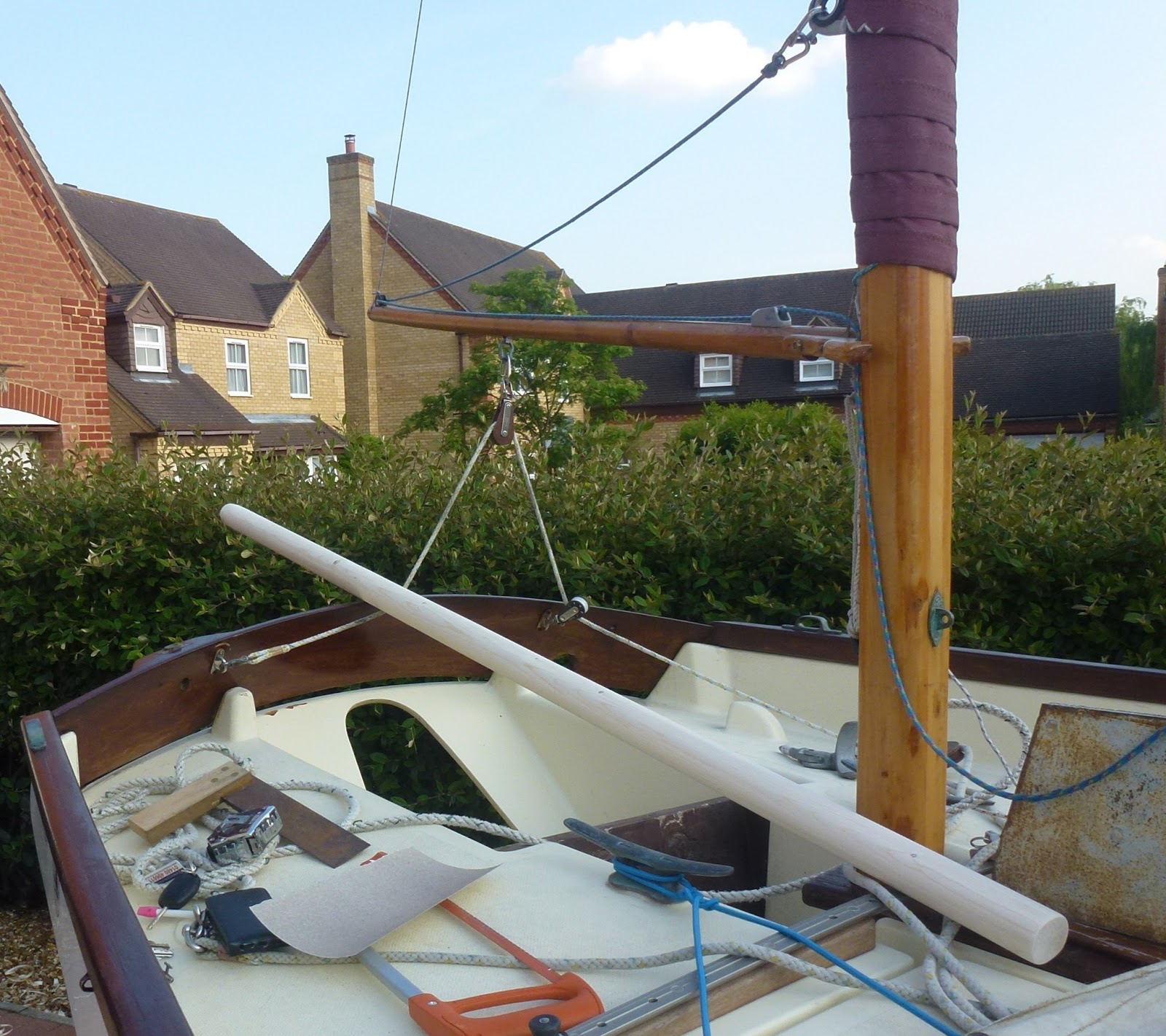
The new boom was made from a piece of 2.4m (shortened to 1.73m), 45x45mm spruce: the least knotted piece to be found in Homebase!  Planing along each edge length-wise, this became octagonal and, subsequently, crudely hexadecagonal in cross-section.  A surform helped form the rounded end.  Sanding with, respectively, 80, 120, 180 grit paper left a reasonably cylindrical piece of wood (in fact, by accident rather than design, slightly oval in cross-section, which is handy in hopefully providing more vertical strength when appropriately positioned).  This task took a couple of hours.
Left to right, original timber, after various stages of planing, after sanding
Ring out the old, ring in the new
The gooseneck needed securing to both mast and boom.  The mast needed reshaping, since the gooseneck jaws were semicircular, next to the square cross-section of the mast.  Using a chisel and Black and Dekker Powerfile belt sander, a horizontal channel was cut in the mast to fit the jaws of the gooseneck - not my best piece of woodwork and a little retrospective filling may yet be in order.
Gooseneck attached to mast
The other end was tapped, gently but securely, into a hole drilled in the non-rounded end of the boom.

Put together, with rigging attached, it looks like this:
New boom, unvarnished but rigged and in place
Everything is now disconnected ready for action from varnish and brush. Next weekend's Wells-next-the-sea rally will provide a great, first opportunity to try out the new arrangement.

The other modification, currently in preparation, copied directly from a device being used by the skipper of coaster Windsong which I noticed at the recent Pitsford Rally, is a wooden support for a ratchet strap used to secure hull to trailer when towing.  The design allows the strap to be tightened without causing undue stress to the hull.
Ratchet support
The support will have leather softening on the underside in contact with the gunwhales, and I might need to look at ways of ensuring the metal ratchet itself stays on the support.  Again, there will be an opportunity to put this to the test on the way up to Wells-next-the-Sea next weekend.